Call Us To Schedule Your Next Appointment


You finally decide to look into microneedling after seeing enough before-and-after videos to convince yourself it might actually work for your acne scars, enlarged pores, or uneven skin texture. But the moment you start researching, a second decision hits you: SkinPen or RF microneedling?
Suddenly, you are scrolling through comparison videos, clinic pages, and Reddit threads at midnight, trying to figure out why one costs more than the other and whether “more advanced” actually means better results. The terminology piles up fast: collagen stimulation, downtime, insulated needles, radiofrequency microneedling, before and afters that may or may not be edited.
Choosing between the two is not about trends or price points. It is about understanding what your skin actually needs and at what depth. Our Allmed Vitality team breaks it all down so you can walk into your consultation already knowing the right questions to ask.
Choose Confidently with Expert Skin Guidance
At their core, both treatments use tiny needles to create controlled micro-injuries in the skin. These micro-channels trigger your body’s natural healing process, producing fresh collagen and elastin. That is where the similarity ends.
SkinPen is the gold standard of traditional microneedling. It is FDA-cleared, needle-only, and relies entirely on mechanical stimulation: no heat, no energy, just precision punctures that signal your skin to repair itself.
Radiofrequency microneedling adds a powerful second layer. Radio wave energy is delivered directly into the dermis through the needles at the moment of penetration. This heat-based energy targets deeper tissue layers and stimulates significantly more collagen production than mechanical needling alone.
Think of SkinPen as a reliable workhorse. RF microneedling is the workhorse with a turbocharge.
| Feature | SkinPen | RF Microneedling |
|---|---|---|
Mechanism | Needles only | Needles + radiofrequency energy |
Depth of treatment | Superficial to mid-dermis | Mid to deep dermis |
Collagen stimulation | Moderate | High |
Skin tightening | Mild | Significant |
Downtime | 1 to 3 days | 2 to 5 days |
Best for | Texture, fine lines, scars | Laxity, deep wrinkles, body contouring |
Sessions needed | 3 to 6 | 1 to 3 |
When comparing RF microneedling vs microneedling in terms of pure results, RF consistently comes out ahead for moderate-to-severe skin concerns, especially sagging, deep acne scars, and stubborn texture issues that surface-level treatments cannot reach.
During an RF microneedling treatment, insulated needles penetrate the skin at customizable depths. These needles are typically 0.5mm to 4mm, depending on the area and concern. At the moment of penetration, radiofrequency energy is emitted from the needle tips, heating the surrounding tissue to a therapeutic temperature.
This accomplishes two things:
The result? Tighter, firmer, smoother skin with effects that continue improving for 3 to 6 months after each session as new collagen fully matures. Popular devices have slightly different needle configurations and energy delivery systems. This is why your provider’s expertise with the specific device matters just as much as the device itself.
When you look at real RF microneedling before-and-after photos, the results speak for themselves.
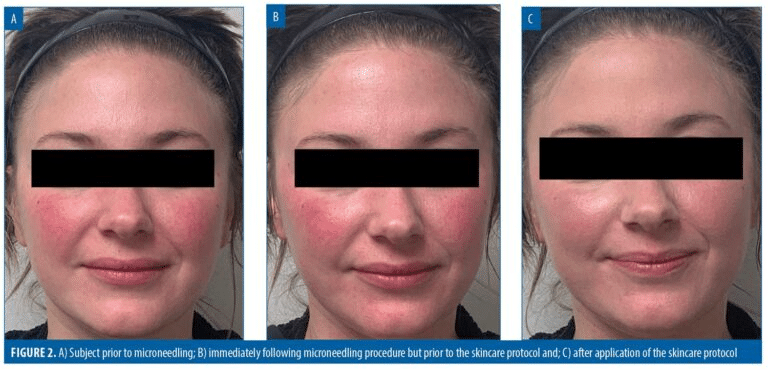
Figure 2. Before, during, and after results of radiofrequency microneedling for facial rejuvenation. Source: Grieshaber E, Glorioso A. J Clin Aesthet Dermatol. 2022;15(5):12–18.
Skin laxity and sagging. The thermal energy contracts existing collagen and triggers robust new production, delivering the kind of tightening that traditional microneedling simply cannot match.
Deep acne scars. By reaching deeper into the dermis, RF energy breaks up fibrous scar tissue far more effectively than needle-only treatments.
Fine lines and wrinkles. From crow’s feet to forehead lines, radiofrequency microneedling smooths and plumps skin gradually.
Pore size reduction. Smaller pores, refined texture, and an overall polished appearance are consistent outcomes reported by patients across skin types.
Stretch marks and body skin. Unlike SkinPen, it is highly effective on the neck, décolletage, abdomen, and arms, making it a genuine full-body rejuvenation option.
The versatility of RF microneedling treatment is a major reason it has become one of the fastest-growing aesthetic procedures in the country.
The best treatment is the one that fits your specific concerns, skin type, budget, and realistic downtime window.
Choose SkinPen if you: have mild texture issues, minor scarring, or early fine lines; want minimal downtime with a quick return to work; are newer to professional skin treatments; or are working with a tighter budget.
Choose RF microneedling if you: want significant skin tightening or lifting; have moderate-to-severe acne scars or deep wrinkles; are treating the neck, body, or jawline; want faster results with fewer sessions; or can commit 2 to 5 days to recovery.
An important tip when sitting down for your consultation is asking to see real RF microneedling before-and-after photos from their own patients, not stock images. At Allmed Vitality, board-certified practitioners deliver precise, personalized results with a focus on safe, natural-looking outcomes. Whether you are comparing clinics or ready to book, choosing a provider who takes the time to assess your skin individually makes all the difference.
Your Skin Called. It Wants Better Results.
Yes. One of the biggest advantages of radiofrequency microneedling over laser treatments is its safety across all Fitzpatrick skin types. Because the heat is delivered beneath the skin’s surface rather than on it, the risk of post-inflammatory hyperpigmentation is significantly lower.
Most patients see improvement after 1-2 RF microneedling treatments. Remember that a full protocol of three sessions is recommended for more severe concerns. Maintenance sessions every 12 to 18 months help sustain results long-term.
Lasers work on the skin’s surface, while RF microneedling works beneath it. Laser resurfacing tends to be more aggressive on surface texture and pigmentation, while RF excels at structural tightening and deep collagen remodeling. Many providers use both in combination for comprehensive rejuvenation.
Initial improvement is visible within one to two weeks after your RF microneedling treatment. Peak results appear at three to six months as new collagen fully matures.
Both SkinPen and RF microneedling are legitimate, evidence-backed treatments. They are simply solving different problems at different depths. Know your concern, know your budget, and choose a qualified provider who will personalize the protocol to your skin. That is how you get results that actually last.